Enjoying Your Dram
Single Malt Whisky is considered to be the best of all of the differing styles of whisky. Single Malt is now produced in many countries around the world but it is Scotch Single Malt whisky that has paved the way in this industry.
Single malts have become a very collectable commodity, and in the past 10 years the value of the most sought after rare malt whisky’s has increased by over 500 %.
But by far, the largest portion of this market is bought to drink, enjoy and appreciate.
“There is no such thing as bad whiskey. Some whiskeys just happen to be better than others.”
~ William Faulkner- Writer and Nobel Prize laureate
The Glass
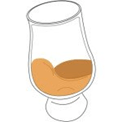
A lot of wine glasses have a tulip shape (to concentrate the aromas) that makes them perfectly suitable for whisky tasting. Conversely, tumblers – wide glasses with no stem that are often considered as the typical whisky glass – are actually inappropriate. A tumbler will reflect only the most ethereal and aggressive notes. For tasting, you need a stemmed glass in order to avoid heating the contents of the glass with your hand, the bowl of the glass should not be too deep so that even the heaviest of the volatile compounds can rise to the top of the glass.
The Glencairn Whisky Glass, similar in shape to the tulip-shaped glass, the Glencairn is considered a more robust vessel, although it’s equally suited to appreciation. Its short, solid base makes for a stable glass popular amongst those who don’t favour stems. The glass is also somewhat thicker and this means it’s more substantial for convivial drinking. Due to its size, this is the perfect glass for learning how to swirl whisky too, a practice commonly used to open up the aromas of whisky for full appreciation. Again, a bowl-shape channels aromas towards a narrowed rim. This glass was designed and solely dedicated to whisky.
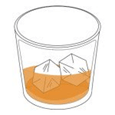
The Whisky Tumbler is the most common of all whisky glasses. Due to its wide rim, the tumbler isn’t ideal for nosing, but it does not need to be – this one’s for filling with ice and a whisky of your choosing, or for serving up any number of classic cocktails. Its wide and robust base makes it ideal for ‘muddling’ cocktail ingredients, while its plain design lets simple drinks speak for themselves. A timeless glass, and a must have for any whisky fan open to the entire spectrum of the spirit’s enjoyment.
Adding Water
Adding water needs to be done in stages:
(i) after having smelled and tasted, at least once, the pure whisky;
(ii) a drop at a time in order to reveal the desired aromas, without diluting the whisky too much.
(iii) The water you add should be slightly cool or of moderate temperature so as not to disrupt the whisky too much.
(iv)The aim is to be able to open up the whisky rather than to dilute it or, worse, break its palate, structure or texture.
Remember this technique is for “tasting” your whisky, which helps in deciding what particular flavours you favour and also what amount of water to add (if any).
Only very soft, still water should be added to whisky. Once the water has been added, a transformation will take place on the nose but also on the palate because it will cause a recombination of the fatty substances and aromas. Adding water does not necessarily make the whisky better or worse, but it does reveal or mask certain aromas. In any event, it will reduce the alcohol content of a whisky and will also open it up if it appears closed:
water always releases aromas.
Appearance
Whisky should be served at room temperature, between 18° and 22°C (64° and 72°F).
The colour and thus possibly the type of cask used for ageing the whisky, or even its age, provided, of course, that no colouring agent (caramel E 150) has been used. Whisky that has not been artificially coloured (‘non coloured’) is preferable as the legal practice of adding caramel can have a negative impact on its aromatic profile.
The clarity and thus the use (or not) of chill-filtration. In fact, if it has not been chill-filtered, a whisky of less than 46% ABV will tend to become cloudy below a certain temperature, or when you add water to it. This opacity has no bearing on the quality of the whisky. It is not a defect but rather is due to the fact that certain compounds are soluble only above 46% ABV. On the other hand, chill-filtration has an effect on the aromatic profile of whisky, causing it to lose fatty acids, proteins and esters and thus to be deprived of richness and complexity.
The viscosity of the whisky. Observing the legs (or tears) of a whisky, and the slowness with which they fall, enables you to assess its alcohol content. In fact, these legs are the result of the difference in surface tension between the alcohol and the water contained in the whisky (the Marangoni effect). As the surface tension is lower in alcohol than in water, the higher the alcohol content of the whisky, the more legs there will be and the slower they will form and fall. In the same way, the more fatty acids the whisky contains, the thicker these legs will be. In addition, the longer the whisky was aged in cask, the more they will tend to separate and space out.
Once you have observed the whisky, stand the glass upright again and wait for a few minutes to allow the aromas to become concentrated.
The Nose
The human nose is capable of analysing more than a thousand billion different aromas (for example vanillin for vanilla). Perceived aromas result from the production and ageing processes of the whisky: primary aromas (varietal and malting) from the type of barley and its malting, such as grain and malt aromas; secondary aromas (from fermentation and distillation), such as yeasty, metallic and milky aromas;
…….. and finally secondary aromas (from ageing), as well as the extraction aromas linked to the type of container in which it was aged. These could be vanilla, spicy, winey or woody aromas. The smoky aroma is unusual in that it can be primary (when it comes from the kilning of the barley) and/or secondary (when it is the result of cask ageing, particularly if these casks were previously used to age peated whiskies or have been heavily toasted). These, then, are the compounds that should be identified.
Tasting
First Stage
Hold the glass upright directly above your nose to allow the aromas time to rise. This enables you to experience the first aromas while allowing your nose time to adjust to the level of alcohol. It is important not to ventilate the whisky (by swirling the glass as you would do for wine) if you want the aromas to remain concentrated. The higher the alcohol level, the more important it is to respect this adaptation phase to prevent your nose ‘burning’. It is at this stage that the lighter volatile compounds can be detected.
Second Stage
While taking care not to spill the contents, turn the glass on its side so that it is perpendicular to your face. Now move the glass upwards in a straight line to assess the different aroma strata. In fact, the aromas from heavier volatile compounds (earthy, smoky, woody, etc. aromas) will remain concentrated at the bottom of the glass. Then, gradually moving up towards the rim, you will notice that the more volatile the particles, the higher they are in the glass: first the spicy, malty and winey aromas, then, higher up, the lighter (and thus more volatile) fruity and floral aromas.
Third Stage
Hold the glass perfectly horizontal: your nose should be directly above the top of the glass slightly away from the rim The circulation of air in the glass will dispel the aromas and the lighter elements will follow the inner surface of the bowl to be deposited at the top of the outer edge of the glass. This technique isolates the very light and volatile elements, such as citric and floral aromas, which are barely perceptible when mixed with more powerful aromas
Fourth Stage
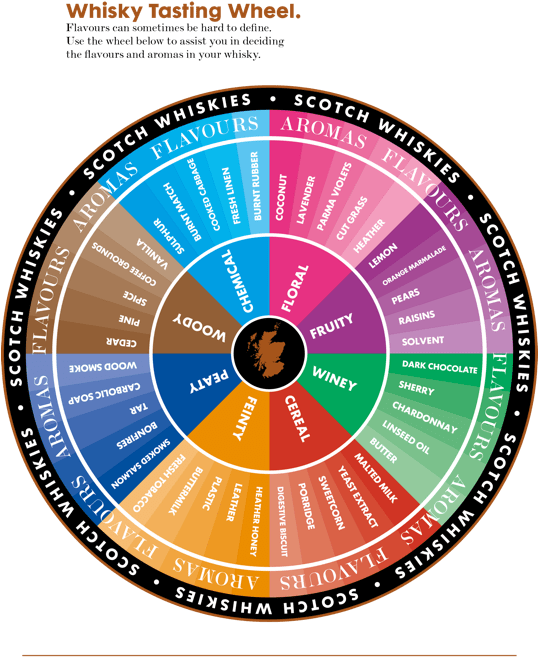
Slowly inhale firstly through one nostril and then the other to maximise the aromas. Determine the aromatic families experienced by referring to the Aroma Wheel. In fact, the way in which we perceive the same aromatic compound may differ, but the element itself will remain unchanged.
Fifth Stage
In the Aroma Wheel, chemical compounds have been grouped into the same family when similarities in their structure reflect aromatic similarities. This method has the advantage of presenting tasters of all levels with a common grammar regarding the characteristics that emerge from the whiskies they are tasting. The Aroma Wheel also enables novice tasters to train their palates by inviting them to learn to taste by processes of deduction – in other words by what a whisky is not in terms of its aromatic profile – as well as by comparison.
Palate
Each type of taste receptor can be stimulated by a wide range of chemical substances but is particularly sensitive to a certain category: sweet, salty, sour, bitter and savoury, astringent, spicy, fatty, mineral (calcium) and metallic.
Sixth Stage
It is important to drink some very soft, neutral water at room temperature before beginning tasting (as well as throughout the process) to prevent variations in temperature and acidity affecting the palate.
Before tasting a whisky, you should also avoid consuming any food or drink with strong tastes that would be likely to alter it (for example coffee, liquorice, mint, etc.)
Finish
The finish corresponds to the stimulation of the sensory receptors by the aromas that are released from the mouth to the back of the throat, lighter whisky’s tend to disappear in the mouth fairly quickly whereas heavier and older whiskies will leave lingering flavours in the mouth.
The Empty Glass:
The empty glass contains the dry extract of the whisky, (in other words all the substances that do not vaporise) Once you have finished tasting a whisky the empty glass should be covered to retain the aromas. The aromas of the dry extract, will remain for several minutes, or even several hours, after tasting. The richer and more woody the aromatic profile of a whisky, the more expressive the aromas it will leave.
 welcome to the art of whisky