The Distilling Process
Scotch whisky is typically distilled twice in copper pot-stills. The size, shape and number of stills have a big influence on the taste of the whisky, due to the spirit’s interaction with the copper. Generally, the more the spirit interacts with the copper in the still, the lighter the spirit.
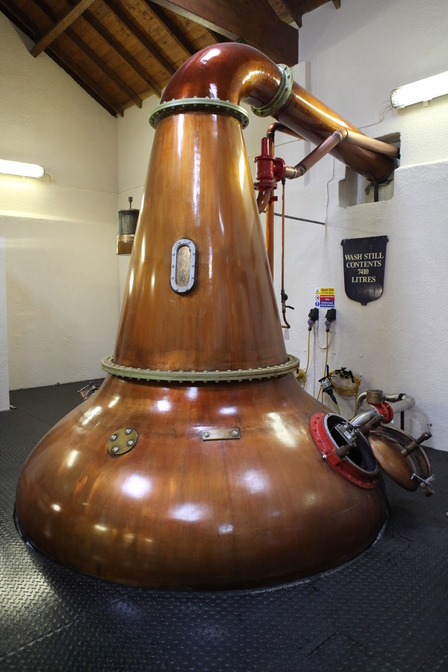
You might think of the still as a big kettle with a fire underneath it. The liquid wash is heated to a point at which the alcohol becomes vapour. This rises up the still and is passed into the cooling plant where it is condensed into liquid state. The cooling plant frequently takes the form of a coiled copper tube or worm that is kept in continuously running cold water.
Stills
Shallow Still c1786
This still was the distillers answer to dealing with the 1786 Amended Wash Act which taxed on the expected output of a still being discharged at a rate of once a day. The Steins experimented with several new designs of stills but soon realised that a shallow still with an enlarged bottom coupled to a larger furnace would bring the wash to the boil much quicker. This gave the Scottish distillers a much improved discharge rate of anything up to 94 times in a 24 hour period basically giving them duty free production.
Continuous Still 1826 (or Patent Still)
Invented by Robert Stein of Kilbagie in 1828
Most historians describe the Steins as a great whisky dynasty, probably one of the greatest understatements you will ever read. The Steins revolutionised both the Scottish and Irish whisky industries, but without a doubt the family were also one of the greatest Scottish industrialists of their time. The distilleries founded by the Steins were the largest manufacturing undertaking of any kind to emerge during the first decade of the Industrial Revolution in Scotland and Ireland.
Stein had invented a method of continuous distillation which meant spirit could be produced much faster and more efficiently than had previously been the case in traditional pot stills which had to be cleaned and recharged between batches. This advancement should not be underestimated to the importance of the Scotch whisky industry. A large pot distillery could produce 5,000 gallons per year while a Stein still could produce 150,000 gallons – a 30 thirty fold increase.
This ingenious device consisted of a column twenty – thirty feet tall and was divided into a series of small connected chambers by plates made of haircloth. Preheated wash was scattered as a fine fist into the chambers where it came into contact with steam. The alcoholic vapour rose up the column until it condensed as spirit while the water and solids in the wash attached to the haircloth diaphragms dropped down and were removed at the foot of the still. The whisky produced from this still was bland in flavour and high in strength 94 – 96 ABV therefore ideal for rectification.
The first continuous still was located at Kilbagie. By 1826 Stein had obtained permission to run trials at his brother’s distillery at Kirkliston. It did not take long before this new still was in operation throughout the family’s other distilleries. Some of the Stein stills were still in use until the 1920s.
Pot Still
Pot still distillation is a batch process. Each pot still consists of an upper and a lower part. While the lower part is designed according to the technical specifics of firing, the shape of the upper part determines the taste and the character of the new make spirit. The lower part of the pot still is basically a big round cauldron with a special bottom.
The gas-fired lower part of a pot still has to have a thickness of at least 5/8″ (16mm), so that the aggressive flames from the outside and the scraping rummager from the inside do not reduce the wall thickness below the allowed minimum too fast. The cone-shaped side walls have to be 3/8″ (10mm) thick as well, because the outside of the copper is heated up to 1200°F (650°C) in this fire flue.
In the 1970s most pot stills were still fired with coal. Today indirect heating with hot steam is widely used. A big water boiler fuelled with oil or natural gas is heated, and the hot steam is led through insulated pipes in a closed heating system inside the pot still. The overheated steam gives off heat to the liquid inside the stills, and the steam condenses back to water. This water is pumped back into the boiler and is reheated in the circuit. The first distillation happens in the larger wash still, where the wash is heated, and before the boiling point of alcohol is reached a condenser transforms that vapour into a liquid known as low wines with an alcoholic strength of around 20%. The more volatile fore shots evaporate first. These fore shots are predominantly light compounds such as ethyl acetate and volatile esters, which have a pungent aroma.
The low wines are heated again in a spirit still, which is a smaller version of the wash still. It vaporises and condenses again and the liquid, now at around 69.5% alcohol, flows through into the spirit safe.
Distillation in Pot Stills
First Distillation
The wash is filled into the first copper pot still called a ‘wash still’ and is heated from below and from the inside respectively. Today mainly hot steam is used for heating. ( an external gas flame is not used so often in modern distilleries )
In the first case, hot steam is lead through specially shaped heating tubes inside the pot still, thereby heating the wash. At 78° C, the alcohol starts to evaporate before the water does. The alcohol steam rises in the tapered tube called a ‘swan-neck’, over the neck and the lyne arm to a condenser where the alcohol steam is liquefied again.The most of the water remains in the wash still.
All Single Malt Whisky distilleries work with at least two connected pot stills. The wash still distills the wash to 20% to 25% of alcohol. The resulting liquid is called “low wines”.
Second Distillation
The low wines are then transferred into the second pot still, called the low wines still or ‘spirit still’ for the second distillation, to increase the alcoholic strength as well as build more flavour. Some of those notes out of the distillation are apples, pears, lemon, and banana. It will also develop fragrant organic compounds – these compounds are known as “esters”.The ‘low wines’ are distilled to an alcohol content of 65% to 70%.
Distillers can control the temperature and distillation times to influence what’s called the ABV (alcohol by volume). The size of the pot still also influences which aromatic molecules volatilise and make it up and over the still’s swan neck. The very lightest, lithe esters rise up swan necks whereas if the neck is shorter, some of the heavier molecular compounds can make their way over the neck. Distillers monitor the distillate coming off the spirit still, collecting the most flavourful of the liquid, called the “heart.” Other parts of the distillate, called the “heads” and “tails,” refer respectively to the first and last moments of the distillate coming off the still. Those are re-distilled or discarded, as they contain undesirable molecular compounds that don’t make for tasty whisky. Where these “cuts” take place depends mostly upon the distiller’s taste and the still used.
Pot stills are made of copper, a material that interacts with molecules to enhance the distillate profile, especially sulphuric compounds that are created when yeast metabolizes during fermentation.
In the Scottish Lowlands these days, only Auchentoshan still has three pot stills and ‘triple distills’ their single malt.
In general, pot stills create more robust distillates and often retain more raw ingredient flavours than other types of stills. Grain is usually distilled to around 94.8% alc/vol.
The Spirit Safe
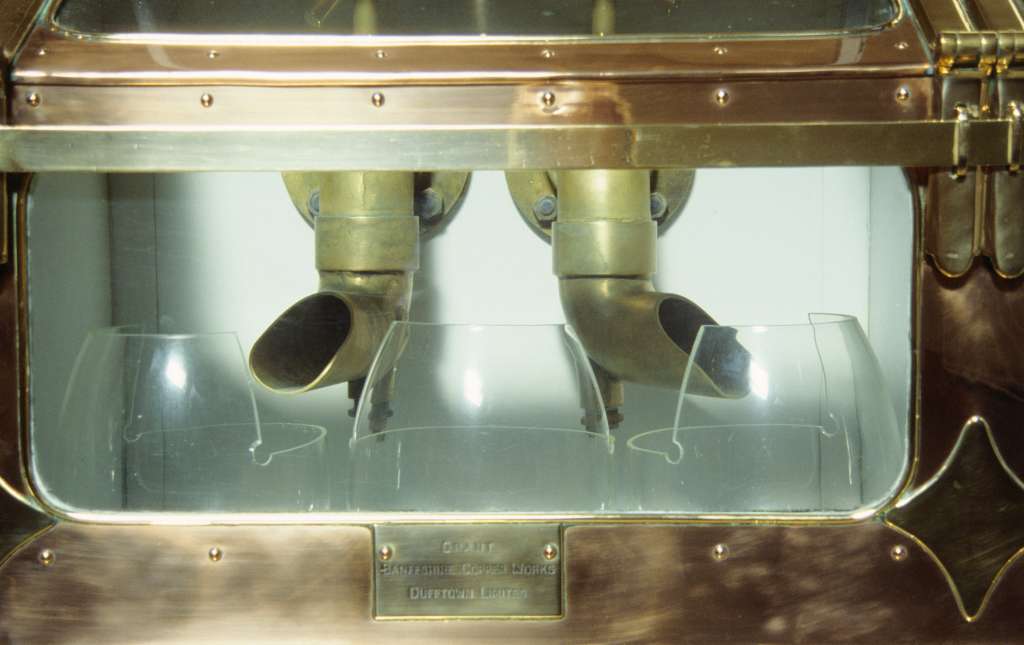
The spirit safe was first introduced in 1823 with the enactment of the Excise Act in Scotland (the very first distillery to have a spirit safe was Port Ellen). It’s a padlocked, box-shaped apparatus
made of metal and glass that encloses the point at which spirit exits the still and enters the spirit safe.
This explains why spirit safes carry large and obvious padlocks, and why all the manipulation and measurement takes place behind its glass panels, using controls on the front of the spirit safe. Until 1983 the only keys to the padlocks were held by the local officer from the Customs and Excise, who also measured how much spirit was produced. Since then the keys have been held by the distillery manager, and Customs and Excise ensure compliance by analysing and comparing returns across a range of distilleries. The first liquid to emerge from the spirit condenser as the spirit still is heated is the undesirable fore shots, and these are directed from the spirit safe to the low wines and feints receiver for re-distillation. But gradually the alcohol content reduces and what emerges is the spirit that will end up as Scotch Whisky. The distiller has to judge the right moment to redirect the flow of product to the spirit receiver instead of the low wines receiver.
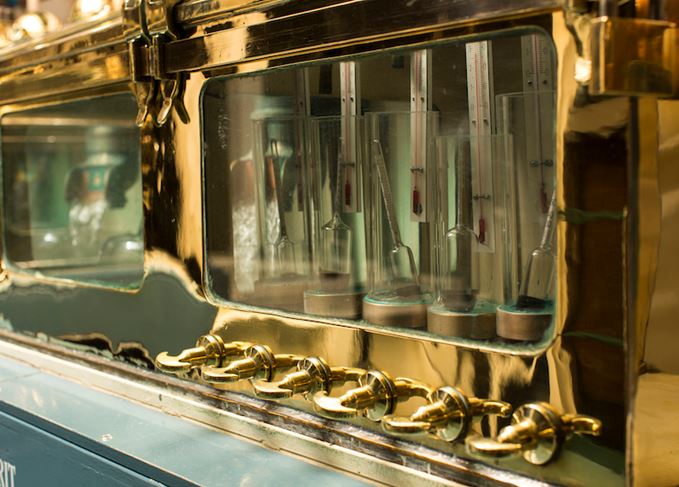
This is when the alcohol content, measured by a hydrometer in the spirit safe, falls to 75%: or when the emerging spirit no longer turns water cloudy, another test conducted remotely inside the spirit safe.
The alcohol content of the emerging liquid continues gradually to fall during the run. When it reaches a point between 70% and 60% alcohol by volume, again as measured by a hydrometer within the spirit safe, the flow is switched away from the spirit receiver and back to the low wines and feints receiver, again for re-distillation. The precise point at which this switch takes place depends on the character of the whisky being produced: but for a particular whisky this will always happen at the same point in the run.
The Spirit is directed from the spirit safe to the spirit receiver (or spirit vat).
It is then used to fill casks for maturation in the warehouse.
Under British law all pot stills and pipework must be padlocked. So the stillman cannot taste the spirit. Here, the distillers use their skills and experience to select only the pure, middle cut of the spirit that is produced, in doing so, ensuring that the high quality of our whisky is maintained.
Filling and Maturation
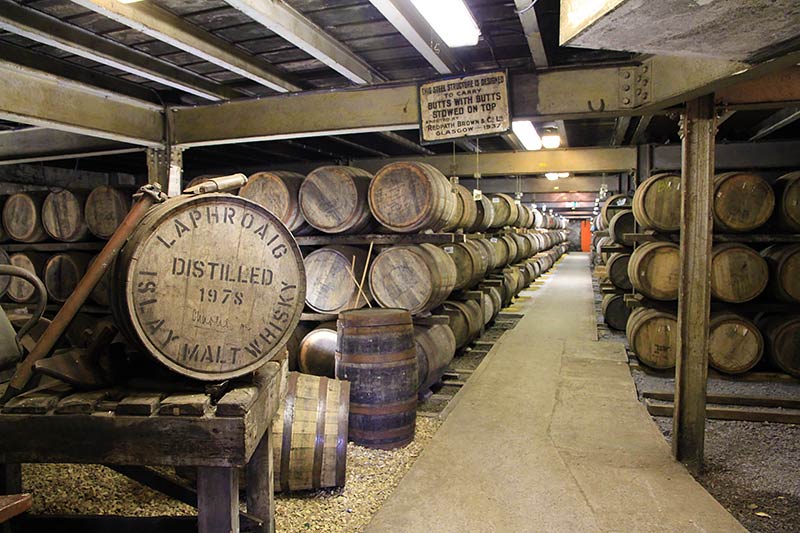
Once the spirit has been produced in the spirit still, it is directed via the spirit safe to one or more spirit receivers. It is then placed in casks for maturation in bonded warehouses.
The cask filling is not the most glamorous stage in whisky production, but it is one that takes place at every distillery you are likely to visit. Casks are manoeuvred by hand to an area below the raised spirit receiver (or vat). The spirit is then fed via pipes into the cask. When full, a bung is fitted in place and the cask moved off to the warehouse to begin the slow process of becoming Scotch whisky.
Malt whisky is aged in casks which can be used more than once.
A cask used for the first time is referred to as a first fill, which could for example mean a 12 year aging period, before the cask is emptied and filled with new make spirit for a second time, when it’s referred to as a second fill. Casks may be filled a third or even fourth time. Each fill has a different influence on the flavour of the resulting malt whisky, which means the fill is a significant factor.
Casks have previously been used to age either bourbon or sherry, with each type of cask contributing a different range of flavours to the maturing malt whisky. Bourbon barrels add, for example, vanilla and a light sweetness, while sherry casks lend richer sweetness with a range of fruit cake and dried fruit notes.
Each time a cask is filled the influence of the oak on the maturing malt whisky is reduced.
Scotch Malt whiskies have to be matured in oak casks for a legal minimum of 3 years before they can be called ’whisky’ but some are matured for 50 years or more.
Enjoying Your Dram
“There is no such thing as bad whisky. Some whiskies just happen to be better than others.”
~ William Faulkner- Writer and Nobel Prize laureate
A lot of wine glasses have a tulip shape (to concentrate the aromas) that makes them perfectly suitable for whisky tasting. Conversely, tumblers – wide glasses with no stem that are often considered as the typical whisky glass – are actually inappropriate. A tumbler will reflect only the most ethereal and aggressive notes. For tasting, you need a stemmed glass in order to avoid heating the contents of the glass with your hand, the bowl of the glass should not be too deep so that even the heaviest of the volatile compounds can rise to the top of the glass.
Adding Water
Adding water needs to be done in stages: (i) after having smelled and tasted, at least once, the pure whisky; (ii) a drop at a time in order to reveal the desired aromas, without diluting the whisky too much. The water you add should be slightly cool or of moderate temperature so as not to disrupt the whisky too much. The aim is to be able to open up the whisky rather than to dilute it or, worse, break its palate, structure or texture.
Only very soft, still water should be added to whisky. Once the water has been added, a transformation will take place on the nose but also on the palate because it will cause a recombination of the fatty substances and aromas. Adding water does not necessarily make the whisky better or worse, but it does reveal or mask certain aromas. In any event, it will reduce the alcohol content of a whisky and will also open it up if it appears closed: water always releases aromas.
Appearance
Whisky should be served at room temperature, between 18° and 22°C (64° and 72°F).
The colour and thus possibly the type of cask used for ageing the whisky, or even its age, provided, of course, that no colouring agent (caramel E 150) has been used. Whisky that has not been artificially coloured (‘non coloured’) is preferable as the legal practice of adding caramel can have a negative impact on its aromatic profile.
The clarity and thus the use (or not) of chill-filtration. In fact, if it has not been chill-filtered, a whisky of less than 46% ABV will tend to become cloudy below a certain temperature, or when you add water to it. This opacity has no bearing on the quality of the whisky. It is not a defect but rather is due to the fact that certain compounds are soluble only above 46% ABV. On the other hand, chill-filtration has an effect on the aromatic profile of whisky, causing it to lose fatty acids, proteins and esters and thus to be deprived of richness and complexity.
The viscosity of the whisky. Observing the legs (or tears) of a whisky, and the slowness with which they fall, enables you to assess its alcohol content. In fact, these legs are the result of the difference in surface tension between the alcohol and the water contained in the whisky (the Marangoni effect). As the surface tension is lower in alcohol than in water, the higher the alcohol content of the whisky, the more legs there will be and the slower they will form and fall. In the same way, the more fatty acids the whisky contains, the thicker these legs will be. In addition, the longer the whisky was aged in cask, the more they will tend to separate and space out.
The Nose
The human nose is capable of analysing more than a thousand billion different aromas (for example vanillin for vanilla). Perceived aromas result from the production and ageing processes of the whisky: primary aromas (varietal and malting) from the type of barley and its malting, such as grain and malt aromas; secondary aromas (from fermentation and distillation), such as yeasty, metallic and milky aromas; and finally secondary aromas (from ageing), as well as the extraction aromas linked to the type of container in which it was aged. These could be vanilla, spicy, winey or woody aromas. The smoky aroma is unusual in that it can be primary (when it comes from the kilning of the barley) and/or secondary (when it is the result of cask ageing, particularly if these casks were previously used to age peated whiskies or have been heavily toasted). These, then, are the compounds that should be identified.
Tasting
First Stage
Hold the glass upright directly above your nose to allow the aromas time to rise. This enables you to experience the fi rst aromas while allowing your nose time to adjust to the level of alcohol. It is important not to ventilate the whisky (by swirling the glass as you would do for wine) if you want the aromas to remain concentrated. The higher the alcohol level, the more important it is to respect this adaptation phase to prevent your nose ‘burning’. It is at this stage that the lighter volatile compounds can be detected.
Second Stage
While taking care not to spill the contents, turn the glass on its side so that it is perpendicular to your face. Now move the glass upwards in a straight line to assess the different aroma strata. In fact, the aromas from heavier volatile compounds (earthy, smoky, woody, etc. aromas) will remain concentrated at the bottom of the glass. Then, gradually moving up towards the rim, you will notice that the more volatile the particles, the higher they are in the glass: first the spicy, malty and winey aromas, then, higher up, the lighter (and thus more volatile) fruity and floral aromas.
Palate
Each type of taste receptor can be stimulated by a wide range of chemical substances but is particularly sensitive to a certain category: sweet, salty, sour, bitter and savoury, astringent, spicy, fatty, mineral (calcium) and metallic.
It is important to drink some very soft, neutral water at room temperature before beginning tasting (as well as throughout the process) to prevent variations in temperature and acidity affecting the palate.
Before tasting a whisky, you should also avoid consuming any food or drink with strong tastes that would be likely to alter it (for example coffee, liquorice, mint, etc.)
Finish
The finish corresponds to the stimulation of the sensory receptors by the aromas that are released from the mouth to the back of the throat, lighter whisky’s tend to disappear in the mouth fairly quickly whereas heavier and older whiskies will leave lingering flavours in the mouth.

 welcome to the art of whisky